Laser Engraving for Event Gifts That Get Kept
Laser engraving for event gifts turns a branded giveaway into a personal keepsake. Plan materials, live personalization, and premium moments at scale.
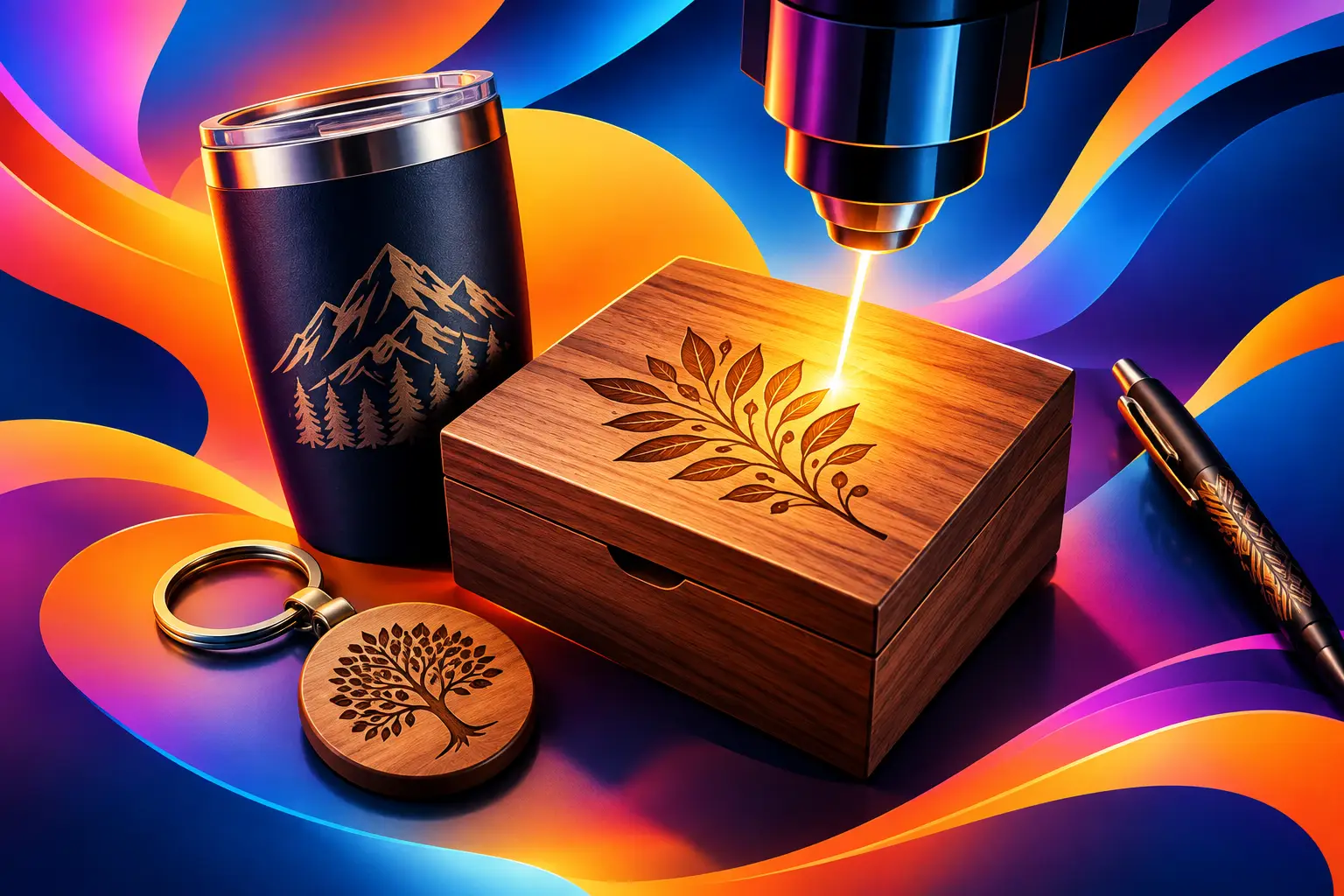
A tote full of identical giveaways is not an event memory. It is logistics with a logo. Laser engraving for event gifts changes the equation by giving attendees a reason to stop, participate, and leave with something that feels chosen rather than handed out.
For event marketers, that distinction matters. The best branded merchandise does not compete for attention in a crowded gift bag. It earns a place on a desk, in a daily carry, or on a shelf because it has a name, a meaningful moment, or a design that could not belong to anyone else.
Why engraving makes an event gift feel personal
Engraving has a physical permanence that printed promotional products often lack. A laser removes or transforms the material surface to reveal contrast, texture, and detail. On wood, leather, coated metal, acrylic, and certain drinkware, the result can feel closer to a retail product than conventional swag.
That premium perception comes from more than the technology. It comes from the attendee seeing the product made for them. Initials on a leather keychain. A nickname on a travel tumbler. A custom illustration on a wood phone stand. A campaign symbol paired with the city, date, or team affiliation that makes the item specific to the occasion.
The brand still has a clear role, but it does not have to dominate the product. That is the shift. Instead of placing the largest possible logo on an object and hoping it survives the trip home, the brand creates a product people want to claim.
Start with the moment, not the object
A laser-engraved gift is only as strong as the experience around it. Before selecting materials, define the attendee behavior you want to create. Is the goal to pull traffic to a trade show booth, reward VIP guests, mark a product launch, support a sponsor hospitality space, or generate content at a festival?
A high-volume conference booth needs a fast decision path. Attendees should be able to choose from a small number of well-designed options, submit a name or short phrase, and watch production happen without creating a bottleneck. A smaller executive dinner can support more considered personalization, such as a monogram, guest-specific artwork, or a locally relevant design.
The right gift also depends on what attendees can realistically carry. A premium engraved tumbler may be ideal for a multi-day summit with a lounge or hotel audience. It is less practical for a crowded music festival where people are moving constantly. Slim leather goods, wooden accessories, luggage tags, and metal keychains travel better in those settings.
The point is not to put a laser on every possible item. It is to match the product, customization level, and production speed to the event’s actual rhythm.
Materials make the difference
Not every blank is engraving-ready, and not every engraved material signals the same thing about a brand. Material selection should begin with the desired feel, durability, and visual contrast - then move to sourcing and throughput.
Wood brings warmth and collectibility
Wood engraves with natural variation, which is part of its appeal. It works especially well for phone stands, ornaments, plaques, coasters, card holders, and display pieces. A slightly different grain pattern on every item reinforces the one-of-one quality.
The trade-off is consistency. Light and dark areas can produce different engraving contrast, and some wood products may need finishing or testing before an event. For a brand that wants a polished, modern look, choose blanks with a controlled finish and test the smallest details in the artwork.
Leather and leather alternatives feel elevated
Leather luggage tags, wallets, journals, patches, and keychains offer a tactile, gift-worthy experience. They are particularly strong for hospitality, automotive, finance, fashion, and premium B2B audiences. A restrained monogram or event mark can look more expensive than a large, full-surface campaign graphic.
Genuine leather has natural variation and a distinct scent and finish. High-quality leather alternatives can offer greater color consistency, easier cleaning, and predictable engraving results. Neither is automatically better. The decision comes down to the audience, sustainability priorities, visual direction, and desired price point.
Coated metal and drinkware support everyday use
Powder-coated tumblers, bottles, and metal accessories can reveal a contrasting layer when engraved, producing crisp marks that hold up to regular handling. They are useful when a brand wants daily visibility after the event, not just a keepsake that sits on a shelf.
These products demand more operational planning. Their shape affects machine setup, and the engraving area is often more constrained than a flat wood or leather item. They can be worth the extra effort when the audience values utility and the event has enough dwell time for production.
Build personalization with guardrails
Giving attendees creative control does not mean surrendering the brand. The most effective activations create a defined design system: approved fonts, prompts, icons, image styles, layouts, and word limits. Within that system, people can make something personal without producing a result that feels off-brand or slows down fulfillment.
For example, a sports sponsor might let fans choose a hometown, jersey number, and illustrated mascot pose. A technology brand could invite guests to generate a future-city visual that is then adapted for engraving on a wood accessory. A leadership summit might offer names, roles, or a short personal mantra in a refined typographic treatment.
Keep the input simple. Asking attendees to choose between six design directions is energizing. Asking them to make twelve design decisions while a line forms behind them is not. The best live customization feels expressive, not like a software onboarding flow.
AI-generated design can add a new layer of relevance when it is directed by a clear brand brief and prepared for the physical limitations of engraving. Fine gradients, tiny text, and overly dense artwork may look compelling on a screen but reproduce poorly on a textured surface. Designs need to be simplified, tested, and converted into engraving-friendly art before they reach the production queue.
Design the production line, not just the gift
An engraving station is a live production environment. Its success depends on queue management, tested artwork, machine capacity, ventilation, staffing, product handling, and a realistic promise to attendees. A beautiful sample item does not prove an activation can serve 500 people during a two-hour reception.
Map the full attendee journey: attraction, design selection, data capture if needed, order confirmation, production, quality check, and handoff. If an item cannot be completed while the attendee waits, provide a clear pickup process or arrange post-event fulfillment. Never let uncertainty become the final impression of the experience.
Throughput should shape creative choices early. A large engraving area, multiple personalization fields, and complex graphics may all increase production time. That may be acceptable for a VIP program of 75 people. For a trade show running thousands of badge scans, the smarter choice may be a smaller engraving zone, a limited set of templates, and a product that loads quickly.
This is where an experienced production partner earns its place. Live Printing AI approaches merchandise as an activation system, connecting the event brief, branded AI design experience, premium product choice, and on-site fulfillment plan. The technology is only impressive when the line moves, the products look right, and attendees want to show what they made.
Measure more than units distributed
Traditional swag reporting often stops at quantity: 1,000 items ordered, 1,000 items handed out. That number says almost nothing about whether the product created attention, conversation, or brand affinity.
For laser engraving activations, track participation rate, average dwell time, completed customizations, pickup rate, social content created, lead quality, and the number of attendees who return with a colleague. If registration or badge scanning is part of the flow, measure opt-in performance separately from product demand. A busy station is valuable, but a busy station that creates meaningful audience data and brand recall is more valuable.
Qualitative signals matter too. Are people debating design options? Are they filming the engraving process? Are they carrying the item through the venue? These are the moments generic swag cannot buy because generic swag asks nothing of its recipient.
When laser engraving is not the best choice
Engraving is not a default answer for every event. If the campaign depends on vivid full-color artwork, photographic imagery, or large apparel graphics, live printing may be the stronger format. If the event is extremely high volume with almost no dwell time, a simpler customization model may protect the guest experience.
There are also budget realities. Premium blanks and on-site laser operations cost more than ordering a pallet of low-cost giveaways. But comparing unit cost alone misses the strategic question: would you rather distribute 3,000 forgettable objects, or create 800 products that people actively value, share, and keep?
A gift is not elevated because it has been engraved. It is elevated when the material, design, personalization, and production experience all support one idea: this was made for me. Give attendees that feeling, and the brand mark becomes part of a story they are happy to carry home.
Ready to run an activation like this?
Start with the AI Product Generator or get a custom quote for your next event.