Live T-Shirt Printing Events That Earn Attention
Live t-shirt printing events turn event swag into a personal brand experience, with custom products attendees keep, wear, and share beyond the venue, too.
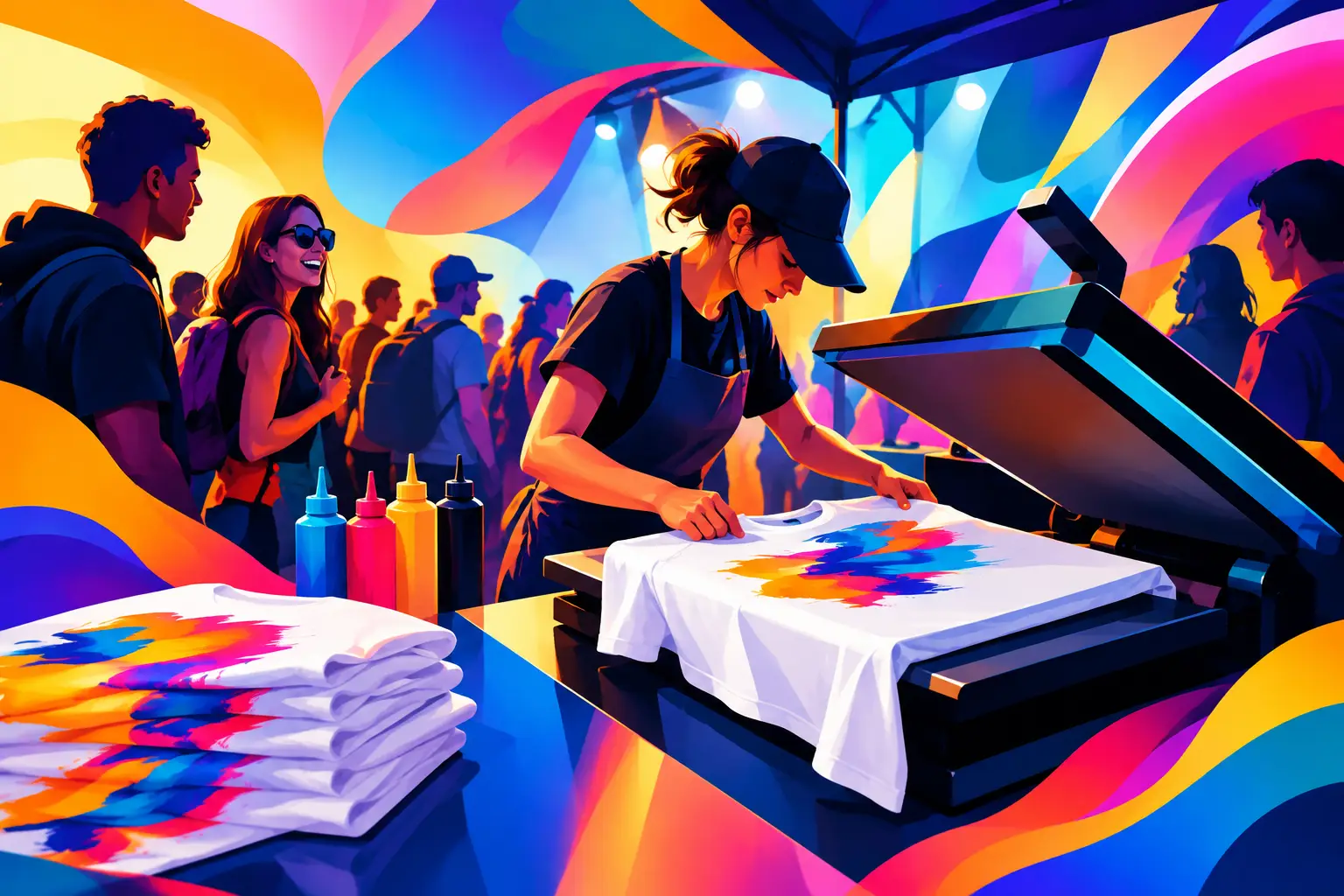
A stack of logo tees on a six-foot table is not an activation. It is a giveaway with a short shelf life. Live t-shirt printing events change the equation by making the product part of the program: attendees create something personal, watch it get produced, and leave with a shirt they would actually choose to wear.
That distinction matters when your event is competing for attention, content, and real brand affinity. The best merchandise is not a consolation prize for stopping by a booth. It is the reason people stop, participate, talk, and return with a colleague.
Why live t-shirt printing events outperform static swag
Conventional event merchandise is built around prediction. You estimate quantities, choose a safe design, order far in advance, and hope the remaining boxes are manageable. The attendee gets what everyone else gets. Maybe it lands. Maybe it becomes the shirt they wear to paint a room.
A live-print experience replaces that model with participation. The attendee selects a graphic direction, adds a prompt, makes a choice that reflects their personality, or interacts with a branded AI design tool. Their shirt is produced on site, often in under thirty seconds. The result is one of infinity, not one of four.
That sense of ownership is the real conversion mechanism. People care more about a product when they had a hand in making it. They photograph it, compare it with friends, and carry the experience beyond the event floor. For brand teams, this turns a physical item into a visible proof point of engagement.
There is also a practical advantage. Made-to-order production reduces the need to gamble on size runs, color preferences, and design popularity. You can bring premium blank apparel in a considered range, print only what is claimed, and avoid the familiar post-event problem of unopened cartons full of yesterday's campaign.
The activation has to be designed, not just printed
A fast printer alone does not make a strong event experience. The best live t-shirt printing events are choreographed around a clear attendee journey, from the first visual cue to the final handoff.
Start with the moment you want people to remember
Before selecting garments or graphic styles, define the behavior the experience should create. At a product launch, the goal may be to turn a new product benefit into a personalized visual. At a conference, it may be to pull qualified attendees into longer booth conversations. At a festival or sports partnership, it may be to create wearable social content with legitimate style credibility.
The brief should answer a few operational questions early: Who is the audience? How many attendees do you expect per hour? What is the event footprint? What should people understand about the brand after participating? The answers shape everything from the design flow to the number of production stations.
A generic prompt such as “make a cool shirt” produces generic outcomes. A focused creative framework produces designs that feel personal while staying recognizably on brand. For example, a technology company might invite attendees to generate their “future work uniform” using the campaign’s color system and graphic language. A beverage brand might create collectible visual worlds tied to music, flavor, or city identity.
Make customization easy enough for a crowd
Attendees should not need a design degree or five minutes of instruction. The interaction needs to feel intuitive at event speed. Too many choices create a line without creating excitement; too few choices turn personalization into a costume change.
A well-configured AI experience gives people a simple entry point and strong creative guardrails. They may choose a mood, a phrase, a character treatment, or a visual style. The branded system then generates an original design that works with the available print method, shirt color, and campaign aesthetic.
This is where generative AI earns its place. It can deliver genuine variation at scale without asking a designer to manually create hundreds of layouts. But the technology should never become the whole story. Attendees remember the feeling of seeing an idea become a retail-quality object in real time. AI is the creative engine behind the curtain, not a gimmick on a pedestal.
Choose product quality that matches the audience
If the shirt feels thin, fits poorly, or looks like disposable promo apparel, the experience loses value at the finish line. Premium blanks matter because they signal that the brand expected the item to have a life after the event.
The right choice depends on the crowd and setting. A fashion-forward festival audience may respond to heavyweight, oversized silhouettes. A corporate summit may call for polished, versatile tees in broadly wearable cuts. A warm outdoor event might favor softer, lighter-weight options. Color also matters: black can feel elevated and graphic, while a brighter blank can make a campaign palette hit harder.
Production method should follow the creative. Direct-to-film printing is strong for colorful, detailed artwork and fast personalization. Other materials, such as tote bags, posters, phone cases, wood, or leather goods, can extend the experience when a T-shirt is not the right fit. The goal is not to print on everything. It is to choose an object people want to keep.
How to protect speed without flattening the experience
High-volume events require discipline. A queue can create social proof, but a stagnant line can drain the energy out of a strong concept. Production planning should account for peak arrival windows, garment replenishment, approval flows, print capacity, and the physical space required for staff and equipment.
For many activations, the sweet spot is a visible production area paired with a separate design or check-in zone. Attendees can begin their creation while others are printing, which keeps the line moving and gives the activation a sense of momentum. Screens that show generated designs or finished shirts can turn waiting time into entertainment.
Staffing also changes the experience. The team should include people who can welcome attendees, guide the design interaction, manage garment selection, and operate production equipment. Nobody should have to choose between solving a technical issue and helping the next person feel seen. Live production is theater, but it is theater built on tight operations.
Build in a clear plan for boundaries. That includes content moderation for AI-generated artwork, limits on prompts, a brand approval system, and an approach for handling special requests. Personalization does not mean abandoning brand standards. The strongest activations give attendees room to express themselves inside a world that still feels unmistakably yours.
Measure more than units printed
A shirt count is useful, but it is not the full performance story. If the only metric is how many units left the booth, a pallet of generic giveaways can look efficient. That is the wrong benchmark for an experience designed to create attention and affinity.
Track participation rate, average dwell time, queue conversion, scan or lead capture where appropriate, and the number of attendees who share or photograph their finished item. Observe what designs people choose, which prompts drive the most enthusiasm, and whether people bring friends back. Those behaviors reveal whether the activation is functioning as a genuine audience magnet.
For sponsorship teams, custom printing can also make a partnership more tangible. Instead of applying a logo to a standard shirt, the sponsor becomes part of an interactive moment attendees actively seek out. For agencies, it creates a physical deliverable with a built-in story: the campaign did not just show up at the event. It gave every participant a unique version of it.
Live Printing AI approaches these programs as end-to-end event production, aligning the event brief, creative system, premium product selection, staffing, and on-site fulfillment before the first attendee reaches the space. That planning is what makes the fast final print feel effortless.
The higher standard for event merchandise
Not every event needs a personalized T-shirt station. If the audience is moving through a space in seconds, or if the campaign requires a simple mass distribution model, pre-produced merchandise may be the sensible choice. Live printing is most powerful when the event has enough dwell time, audience curiosity, and brand ambition to support an experience rather than a handout.
When those conditions are present, the opportunity is bigger than branded apparel. You are giving attendees a role in the campaign. You are replacing one-size-fits-all swag with something they helped author. And when they pull that shirt from their closet weeks later, the event does not feel like a logo they were handed. It feels like a moment that belonged to them.
Ready to run an activation like this?
Start with the AI Product Generator or get a custom quote for your next event.